15 December 2018

Bitcoin in the News : 2018-11 Deeper

In my first 'Bitcoin in the News' post this month, 2018-11 Price, I noticed 'three distinct downward price shifts' and identified their start times. In my second post, 2018-11 More++, I collected November stories from two mainstream financial news services, CNBC and Forbes, with an eye on finding an explanation for the price drops. For this third post, I located three stories from each service that were published around the time of the drops.

CNBC:-

All three stories were by Kate Rooney, 'Markets Reporter'.

Analysts attributed bitcoin's continued sell-off to technical levels and stop orders in the market kicking in after bitcoin fell below $6,000. "The next logical level of support is at $5,000 but if that doesn't hold, the next logical support level isn't until $3,500," eToro analyst Mati Greenspan said in a note to clients Monday. "With all the falling prices lately, this definitely fits the definition of a buyers market."

$5000 didn't hold; $3500 didn't hold. As I write this, mid-December, the bitcoin price is around $3250. Those 'support levels' turned out to be imaginary. As for 'buyers market', that assumes there is real value in cryptocurrency. The article continued,

Others pointed to a split in the cryptocurrency bitcoin cash. That digital currency split into two versions last week -- "Bitcoin ABC" and "Bitcoin SV" -- which analysts said added to uncertainty in broader crypto markets.

U.S. regulators made good on promises to regulate non-compliant cryptocurrency projects last week. The Securities and Exchange Commission announced its first civil penalties against crypto founders Friday as part of a bigger regulatory and legal crackdown aimed at abuses and outright fraud in the growing digital currency industry.

The 'bitcoin cash' fork/split argument is the tail wagging the dog. The 'regulators' argument is plausible, but the threat has been there since shortly after the invention of bitcoin. Why would a crackdown on dubious crypto players affect the price of established currencies?

Some analysts blamed a "fork" in the cryptocurrency bitcoin cash for that initial drop below $6,000. That digital currency split into two versions in mid-November and diverted what's known as "hash power," which some say dragged down the broader crypto markets. Both sides appeared to be selling bitcoin to "fund mining operations to win the battle," Brian Kelly, CEO of BKAM, told CNBC. The $6,000 level could have been a key exit point for some traders. Bitcoin going below it likely triggered "stop losses" which could have exacerbated the selling. Those bitcoin support levels were broken as the cryptocurrency continued to hit lower lows.

Regulatory crackdowns have also weighed on prices.

Fork, stop losses (= support levels), regulatory crackdowns. Same old, same old?

These lower lows are marking key exit points for some traders. Bitcoin going below $4,000 likely triggered "stop losses", predetermined trading levels that often exacerbate the selling. Those bitcoin support levels were broken as the cryptocurrency plunged to new lows.

In recent weeks, regulatory crackdowns have also weighed on prices. The Securities and Exchange Commission announced its first civil penalties against cryptocurrency founders last week as part of a wide regulatory and legal crackdown on fraud and abuses in the industry.

Last week, Bloomberg News reported that regulators are investigating whether bitcoin's rally to almost $20,000 last year was the result of market manipulation. The U.S. Justice Department is investigating whether tether, a controversial cryptocurrency that founders say is backed 1:1 by the U.S. dollar, was used by traders to prop up bitcoin, according to the report, which cited three unnamed sources familiar with the matter.

The first two paragraphs are familiar territory, but that last paragraph deserves further investigation.

Forbes:-

It was not immediately clear what had triggered the sudden sell-off today but tensions in the bitcoin sector are high ahead of a fork of the bitcoin cash cryptocurrency, expected tomorrow. Bitcoin cash, which split from the original bitcoin blockchain last year, will tomorrow split in two again, creating a third cryptocurrency. The two digital currencies will go by the names Bitcoin ABC (core Bitcoin Cash) and Bitcoin SV (Satoshi’s Vision). Bitcoin cash has been highly volatile in the run up the fork, rising as much as 50% over the last few weeks before falling sharply more recently.

I have a small amount of bitcoin cash. In quantity, it is the same amount as my bitcoin, because I received it after last year's fork. In value, it is a small percentage of bitcoin, in the low single digits. I have trouble believing that it has any impact on the wider market.

Fundamentally speaking, the current sell-off is due to two main reasons; regulatory pressure and disagreement within the coin developer community, one of the biggest threats. The SEC reminded the crypto world that it has the final say over anything that smells like a security. The department issued civil penalties against two cryptocurrency companies because they failed to register initial coin offerings as securities. Investors will be given their refund and the firms will have to face fines. The fear is that the SEC may not stop here and might take similar action against several companies that adopted a similar path.

The community needs to stick together and work towards a more meaningful fork. This is because developers, on the one hand, try to convince the world that the supply is limited and, on the other hand, they keep looking at ways of triggering another kind of forks. Forking has become so common that it puts at risk the notion of limited supply altogether.

That last sentence implies that forking is equivalent to dilution. That makes some sense, but it still doesn't explain how a problem with bitcoin cash (BCH) spills over into bitcoin (BTC) or the other cryptocurrencies.

The bitcoin price falls over the weekend do not appear to be linked to any particular fresh news but a continuation of the sell-off sparked earlier this month by the fork of the bitcoin cash cryptocurrency that ignited a civil war between the bitcoin rival's two factions. Low trading volumes over the holiday weekend, however, mean the market is more vulnerable to so-called "whales" moving large amounts of bitcoin, ripple (XRP), or ethereum. When a major coin holder sells it can trigger automatic computer controlled sell orders leading to sudden sell-offs.

After reading those stories, I looked at another article, also from Forbes, specific to the bitcoin cash fork.

Thursday was a volatile day on the cryptocurrency markets with Bitcoin Cash forking into two different currencies, BCHSV and BCHABC creating considerable hash wars which are ongoing.

That was the lead sentence, after which there were no further mentions of BCH. Instead there were a number of cheerleading statements from people whose destinies are tied to the crypto markets. The writer of the story closed by saying,

All very positive but what most of these people seem to forget is that the market has been sinking for a long time and absolutely no signs of an uptick are present. Price levels are, in many cases, 90% down from their all-time highs just a few months ago. Use cases are bountiful but is there any mass adoption going on out there? In most cases, it seems that cryptocurrencies and blockchain are being used in countries where the economy is totally broken, such as Venezuela and Palestine. Adding to the dubious prevalence of money laundering schemes and scams in eastern European countries such as Belarus (who incidentally are also legalizing cryptocurrencies), the future looks pretty bleak.

When I checked my account to see the quantity/value of BCH vs. BTC, I found three new currencies available for trading: 0x (ZRX), Basic Attention Token (BAT), and Zcash (ZEC). I looked at a few external pages to find out what they were, then bought a small quantity of each. The best way to learn about the crypto markets is by participating, although always with non-essential money.

Before closing this post, I looked at that mention of 'market manipulation' in the last CNBC story quoted above. I found another CNBC story linked from my '2018-11 More++' post, also by the same writer as the other three:-

As bitcoin continued its downward slide Tuesday, U.S. regulators are reportedly looking into whether its record-breaking rally last year was the result of market manipulation. The U.S. Justice Department is investigating whether traders used tether, a controversial cryptocurrency that founders say is backed 1:1 by a U.S. dollar, to prop up bitcoin, according to a report from Bloomberg News, which cited three people familiar with the matter.

As for the mechanics of how that might have happened, I will leave that for another time.

08 December 2018

Bitcoin in the News : 2018-11 More++

In last week's post, Bitcoin in the News : 2018-11 Price, I wrote, 'The month of November 2018 must show the worst chart for bitcoin during nearly two years.' I summarized the post with:-
When I look at the chart I see sideways price movement (= no movement) for the first half of the month, followed by three distinct downward price shifts. [...] These downward shifts can be roughly pegged to these start times:-
- 14 Nov 06:00
- 19 Nov 00:00
- 24 Nov 12:00

How to explain the drops? In separate 'Bitcoin in the News' posts a few months ago I highlighted two mainstream financial news services...

...by showing which stories had been published by the two news services. Let's do the same for November, comparing the stories from both services with the goal of understanding the November price movements. Of course, this isn't a comprehensive look at all of their stories -- it's a list of stories that were flagged by Google News, using whatever its criteria are.

CNBC:-

Forbes:-

Why are there more stories from Forbes? Because the service appears to have more writers covering the bitcoin++ topic. Since I have one extra Saturday this month to explore the topic, I'll use it to take a closer look at the relevant stories from both sources.

Before closing today's post, I have one more story to highlight. It's related to the first CNBC story, 'Bitcoin turns 10 years old':-

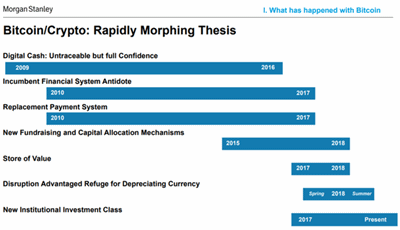
The story is based on a Morgan Stanley report and copied the following chart.


'The evolution of bitcoin'

From 'Digital Cash: Untraceable but full Confidence' (Ha!) to 'New Institutional Investment Class' (Huh?), the 'Bitcoin/Crypto' believers have been one chasing one elusive thesis after another.

01 December 2018

Bitcoin in the News : 2018-11 Price

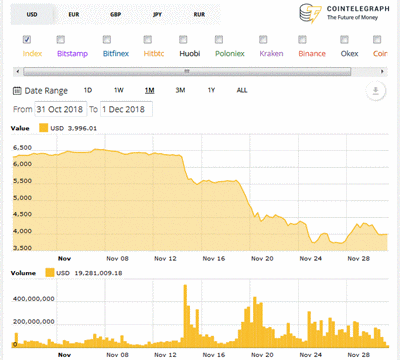
Next month, January 2019, will mark two years since I've limited this bitcoin blog to two posts per month, where the first post has been a chart of the previous month's price movements. The month of November 2018 must show the worst chart for bitcoin during the nearly two years.


Bitcoin (BTC) Price Index (cointelegraph.com)

When I look at the chart I see sideways price movement (= no movement) for the first half of the month, followed by three distinct downward price shifts. Using the same mouseover mechanism that I noted last month in Bitcoin in the News : 2018-10 Price, these downward shifts can be roughly pegged to these start times:-

  • 14 Nov 06:00
  • 19 Nov 00:00
  • 24 Nov 12:00

Looking at the stories in Cointelegraph's Analysis category (in which there are less than half the number of stories for October), only one story addresses (the first two of) the three drops.

2018-11-22: What Is Going On With the Crypto Markets, Analysts Unpack Factors Behind 10-Days Slump • 'Over the last 10 days the cryptocurrency markets have endured a massive sell-off across the board. There are a number of reasons that have led to the highly bearish sentiments on the market but seeing red has been difficult for many. As the value of Bitcoin and numerous altcoins have continued to decline to depressing levels, and a certain amount of panic has ensued.'

A graph of 'Total Market Capitalization' (of what, exactly, isn't clear) shows the market cap going from just over $200B to $150B starting 14 November. The first discussion in the story reduces to:-

'Main factors to consider' : Bitcoin Cash fork, Regulatory pressures, Global pressures (e.g. Brexit)

The other discussions are:-

'“Does this mean Bitcoin is broken? No”', 'Low trade volumes and high uncertainty', and 'A short term outlook'

The 'Bitcoin is broken?' section shows indices for three major American equity markets, all dropping lower on 20 November in tandem. All in all, none of these discussions is particularly revealing and I'm not convinced that this 'What Is Going On' story is anything deeper than cheerleading. Under Cointelegraph's Price Analysis tag, I found three stories coinciding with the drops.

2018-11-14: Bitcoin, Ethereum, Ripple, Bitcoin Cash, EOS, Stellar, Litecoin, Cardano, Monero, TRON: Price Analysis, Nov. 14 • 'Major cryptocurrencies have seen major losses today after months of stability, with Bitcoin reaching a new low for 2018.'

2018-11-19: Bitcoin, Ripple, Ethereum, Stellar, EOS, Litecoin, Cardano, Monero, TRON, IOTA: Price Analysis, Nov. 19 • 'Following the increase in volatility and a renewed downtrend in markets, some analysts have projected abysmally low prices for Bitcoin.'

2018-11-26: Bitcoin, Ripple, Ethereum, Bitcoin Cash, Stellar, EOS, Litecoin, Cardano, Monero, TRON: Price Analysis, Nov. 26 • 'Rampant selling in recent weeks dragged total market capitalization from above $210 billion on Nov. 14 to just below $116 billion on Nov. 25.'

If I had the time, I would look at these analyses in more depth, but I'm again not convinced that I would find any real explanations. Maybe I'll find the time to look at them when I work on the second post this month, like last month's Bitcoin in the News : 2018-10 More++.

Back to the November chart above, I noticed that there are three additional price sources available over what was shown in the '2018-10 Price' post.

(A : 2018-10 Price) Index, Binance, Bitfinex, Bitstamp, Gdax, Hitbtc, Kraken

(B : 2018-11 Price) Index (A1), Bitstamp (A4), Bitfinex (A3), Hitbtc (A6), Huobi, Poloniex, Kraken (A7), Binance (A2), Okex, Coin

That brief (A/B) analysis shows that one source disappeared between (A) and (B), 'Gdax', and four were added. It might again be useful to look at these changes in more depth, but at least I've flagged the keywords for any future searches on this blog.

10 November 2018

Bitcoin in the News : 2018-10 More++

In my previous post, Bitcoin in the News : 2018-10 Price, I observed,
The price moved mostly sideways during the month. The exceptions were two sharp shifts with a large spike in volume, where a mouseover on Cointelegraph's original chart generates crosshairs that pinpoint the action to six hour time ranges:-
- 10 Oct between 1800 & 2400 (=0000 11 Oct)
- 15 Oct between 0000 & 0600
Cointelegraph's Analysis category had no articles to explain these movements.

Could the other news and analysis services explain the sharp shifts? The first of the events, a drop, had a straightforward explanation, which damages bitcoin's reputation as a 'safe haven' for money.

  • 2018-10-11: Bitcoin slumps more than 5%, puts ‘digital gold’ status in jeopardy (marketwatch.com) • 'Bitcoin prices on Thursday finally broke out of a recent lull, dropping as much as 6% [...] The decline comes on the heels of one of the worst sessions for global equities in 2018, putting bitcoin’s “digital gold” status in jeopardy. Bitcoin proponents have argued that the cryptocurrency would be a haven in times of turmoil, just like gold, and go up in value.'

The subsequent rebound was less straightforward. I chose another story from MarketWatch.

  • 2018-10-15: Bitcoin jumps after credit scare; Fidelity enters crypto sphere - MarketWatch (marketwatch.com):- • 'Bitcoin rose sharply Monday after a credit scare on a major cryptocurrency exchange created a rush for the No. 1 digital currency. [...] The move higher in bitcoin came at the expense of Tether (USDT), the stablecoin on the Bitfinex exchange, which traded to 88 cents. A stablecoin traditionally trades at or very close to $1 as it is a U.S. dollar backed coin that investors use to trade between different cryptocurrencies as opposed to going in and out of fiat.'

Tether the stablecoin? Sounds like an exercise involving horses. In fact, my '2018-10 Price' post gave a similar explanation -- 'Stable coin Tether is being cited as one of the main reasons for the spurt in crypto prices' -- although I failed to understand its meaning at the time. Here's another story from a reputable source.

  • 2018-10-15: Bitcoin Has Leapt Sharply Higher -- Here's Why (forbes.com):- • 'Bitcoin, which just last week had its first major sell-off in months, has this morning jumped almost 10% [...] The sudden rise in the bitcoin price this morning was signaled by a sell-off of the dollar-linked tether digital coin — the only cryptocurrency which is down today, according to CoinMarketCap data. Traders often sell tether to buy other cryptocurrencies and a sudden influx of tether sellers would push down the tether price — and boost the bitcoin price if that's what traders are moving their money to. Tether was down by some 3% in the run up to bitcoin's sudden price rise.'

This sounds suspiciously like the cart leading the horse. The phrase 'signaled by' doesn't necessarily imply a cause-effect relationship. It could be a side-effect, like smoke rising from a fire. As long as I'm on animal analogies, whales also received some attention. Here's another analysis from MarketWatch.

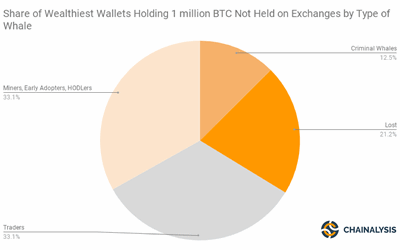
  • 2018-10-18: Bitcoin whales aren’t responsible for volatility, research firm finds:- (marketwatch.com) • 'The bitcoin whales are back. At least, that’s the conventional narrative that takes hold when the world’s largest cryptocurrency exhibits significant price swings, often over a short period. However, new data from Chainalysis, a blockchain research firm that specializes in detecting fraud and money laundering, suggest this isn’t to be the case. In fact, it is quite the opposite.'

The following chart shows four categories of whale, one of which is 'Lost'.

The last day of October marked a significant milestone in the bitcoin saga.

  • 2018-10-31: Factbox: Ten years of bitcoin (reuters.com) • 'Bitcoin, the world’s first and most famous cryptocurrency, celebrates its tenth birthday on Wednesday [31 October].'

The 31st of October is also known as Halloween. How's that for a scary coincidence?

03 November 2018

Bitcoin in the News : 2018-10 Price

In last month's Bitcoin in the News : 2018-09 Price, I had trouble capturing the price chart for September. This month I simply forgot -- 1 November is a public holiday in many Catholic countries -- and didn't get around to it until today. Note that for the first time in these monthly 'Price' posts the 'Date Range' is displayed even though I haven't specified it.


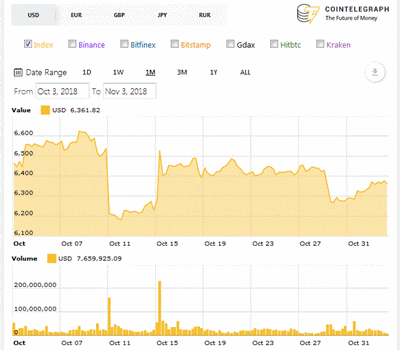
Bitcoin (BTC) Price Index

The price moved mostly sideways during the month. The exceptions were two sharp shifts with a large spike in volume (plus a smaller shift later in the month), where a mouseover on Cointelegraph's original chart generates crosshairs that pinpoint the action to six hour time ranges:-

  • 10 Oct between 1800 & 2400 (=0000 11 Oct)
  • 15 Oct between 0000 & 0600

Cointelegraph's Analysis category had no articles to explain these movements. The site's Price Analysis tag, which brings together posts based on technical analysis, had three articles which glossed over the sharp swings.

2018-10-13: Top 5 Crypto Performers Overview: TRON, Bitcoin, Litecoin, EOS, Cardano

On October 11, the total market capitalization of the cryptocurrencies plunged below $200 billion for the first time since September 20, as a global risk-off trade led investors to dump their holdings. However, the encouraging sign is that the sell-off was short-lived and most currencies are trying to claw back.

2018-10-15: Bitcoin, Ethereum, Ripple, Bitcoin Cash, EOS, Stellar, Litecoin, Cardano, Monero, TRON: Price Analysis, October 15

Stable coin Tether is being cited as one of the main reasons for the spurt in crypto prices that pushed total market capitalization above $221 billion on Monday (UTC time), but it was not a new issuance of Tether that was the catalyst for upward market movement.

2018-10-17: Bitcoin, Ethereum, Ripple, Bitcoin Cash, EOS, Stellar, Litecoin, Cardano, Monero, TRON: Price Analysis, October 17

While crypto markets have given up much of their Oct. 15 gains, they are still trading well above the recent lows, which is a positive sign. A knee-jerk reaction to a news event can propel the markets only to a certain level, after which fundamentals take over. The next leg of the up move will be based on strong fundamental news flows.

Last month I used a second post, Bitcoin in the News : 2018-09 More++, to analyze a similar drop. I'll do the same for October in my next post.

13 October 2018

Bitcoin in the News : 2018-09 More++

In last week's post, Bitcoin in the News : 2018-09 Price, I noted,
None of the stories in Cointelegraph's Analysis category attempted to explain the drop at the beginning of the month.

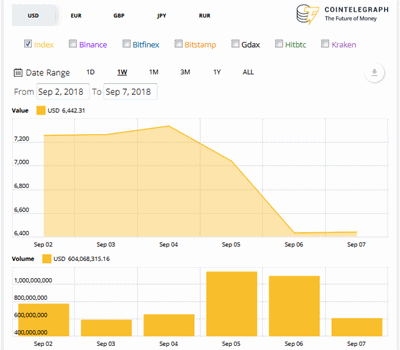
Here's a similar chart showing just the week when the drop occurred. For the record, 5 September was a Wednesday.

It's not a very good chart. The only prices shown are from the midpoint of each day (noon?, GMT?) and are connected with a straight line. The first story I read about the drop was from CNBC:-

  • 2018-09-05: Bitcoin falls after Goldman reportedly drops crypto trading plans (cnbc.com; 'Published 9:00 AM ET Wed, 5 Sept 2018 Updated 4:50 PM ET Wed, 5 Sept 2018') • 'Bitcoin slipped below $7,000 Wednesday after a report that Goldman Sachs is abandoning plans to open a trading desk for cryptocurrencies. Goldman still sees the regulatory environment as ambiguous, according to Business Insider, which cited people familiar with the matter.'

By coincidence, the second story I read was from Business Insider:-

  • 2018-09-05: Bitcoin price: Cryptocurrencies drop suddenly with no explanation (businessinsider.com; Sep. 5, 2018, 4:09 PM) • 'Cryptocurrency prices plunged across the board suddenly and sharply Wednesday morning, seemingly with no clear reason. Having been steady at about $7,350 a coin during most of trading during both Asian and European morning hours, bitcoin lost more than $200 in mere minutes starting about 5:50 a.m. ET, or 10:50 a.m. BST.'

Both stories, from CNBC and from Business Insider, pointed to another story from Business Insider:-

Note that the 'earlier' story is dated three days after the 'later' stories. There is probably a good explanation for this, but I can't think of one. The CNBC story has a detailed price chart showing a steady price followed by two sharp drops: one just before 6 AM (EDT) and another at 7 PM. It's hard to believe that unconfirmed news about a single trading desk could cause such a sudden price shift, but what do I know? Then there was another sharp drop into the following day. I wonder what caused that.

06 October 2018

Bitcoin in the News : 2018-09 Price

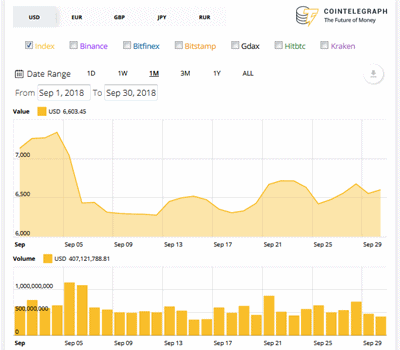
The price chart for September is a bit different than it was for last month's Bitcoin in the News : 2018-08 Price. When I tried to capture the monthly price chart on 1 October, I received only current prices with no chart. When I tried to capture the same chart while preparing this post, I received the normal chart with the first week of September missing, because the monthly chart only goes one month back. The first week of September showed a large price drop, so I couldn't just ignore it. What to do?

Since February, the Cointelegraph price service has offered the possibility of entering a from-to date range. I set this to 1 September through 30 September and received the chart shown below. The data granularity for a specified date range appears to be a full day; the granularity of the monthly chart appears to be six hours. That accounts for the difference in the look of the chart.


Bitcoin Price Index

None of the stories in Cointelegraph's Analysis category attempted to explain the drop at the beginning of the month. Of the 30 or so stories in the category, one in particular caught my attention:-

  • 2018-09-11: The Crypto IPO Race Is On: From Mining Companies to Exchanges • 'Last week, at least two crypto-related enterprises, a Silicon Valley stock and cryptocurrency trading platform Robinhood and Singapore-based crypto exchange Huobi, moved closer to going public by holding an initial public offering (IPO).' The ‘old school’ way to collect investments might seem especially attractive in the context of mass adoption trends and a declining ICO market, which now sees its hardest slump in 16 months.

Using Cointelegraph's tag for technical analysis, Price Analysis, I'll point to a sample article from mid-month:-

The language in that analysis is decidedly negative. In the initial survey, it quotes a sector expert saying,

Bitcoin will resurge in 2019 but altcoins "will never come back."

The phrases 'bearish patterns', 'trend remains down', 'breakdown of the support zone', 'strong downtrend', and 'facing resistance' are used for the first five of the ten cryptocurrencies covered. The mania of 2017 is over.