19 March 2016

Online Bitcoin Course

At the end of my previous post, Bitcoin at Princeton, I noted a free online course Bitcoin and Cryptocurrency Technologies. The signup page says,
There’s a lot of excitement about Bitcoin, but also a lot of confusion about what Bitcoin is and how it works. We’re offering this course focusing on the computer science behind Bitcoin to help cut through the hype and get to the core of what makes Bitcoin unique.

The signup process was quick and within minutes I was watching the first video.


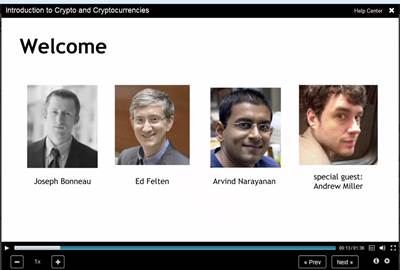
'Welcome to Bitcoin and Cryptocurrency Technologies'

The course starts with 'Lecture 1: Intro to Crypto and Cryptocurrencies', where the first video is 'Cryptographic Hash Functions'. I have a degree in math and computer science and have worked all of my professional career with various aspects of computing. About ten minutes into the first video, I suddenly realized I wasn't understanding the lecture. Then when I reached the end, I couldn't answer the first question. Looks like I'll have to apply some real brainpower to this thing if I want to make it work.

12 March 2016

Bitcoin at Princeton

In my previous post, Bitcoin in the News : 2016-02, there was another news item worth special mention: Crypto connoisseurs - Curl up with Princeton's 300-page ode to Bitcoin (theregister.co.uk).

It points to princeton_bitcoin_book.pdf, 'Bitcoin and Cryptocurrency Technologies' by Arvind Narayanan, Joseph Bonneau, Edward Felten, Andrew Miller, Steven Goldfeder, with a preface by Jeremy Clark, ('Draft — Feb 9, 2016'). Since the draft doesn't include a table of contents, I constructed one myself (with page numbers):-

003 Preface — The Long Road to Bitcoin
023 Chapter 1: Introduction to Cryptography & Cryptocurrencies
051 Chapter 2: How Bitcoin Achieves Decentralization
075 Chapter 3: Mechanics of Bitcoin
101 Chapter 4: How to Store and Use Bitcoins
131 Chapter 5: Bitcoin Mining
165 Chapter 6: Bitcoin and Anonymity
194 Chapter 7: Community, Politics, and Regulation
216 Chapter 8: Alternative Mining Puzzles
237 Chapter 9: Bitcoin as a Platform
265 Chapter 10: Altcoins and the Cryptocurrency Ecosystem
293 Chapter 11: Decentralized Institutions: The Future of Bitcoin?
307 Conclusion to the book
308 About the authors

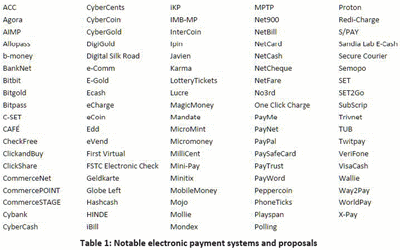
The preface includes the following chart.


Notable electronic payment systems and proposals

A second link in The Register article worth noting is 'Narayanan's free online Bitcoin course': Bitcoin and Cryptocurrency Technologies (coursera.org).

05 March 2016

Bitcoin in the News : 2016-02

After spending most of my February posts on 'Bitcoin in the News : 2016-01' -- Predictions, More++, and Davos -- the month of February itself offered no dominant news themes. Except for the continuing debate on the so-called 'hard fork', the few repeated stories I found were tied together geographically.

Europe:

China:

Russia:

Japan:

Those second Europe and China stories, 'Why Europe Is About To Crack Down...' and 'Why the Great Firewall of China...', are typical of many bitcoin stories. I'll call them the 'Why?' stories.

Those last two stories are related. It's curious that the 'Why?' stories can all be reduced to a single 'Because' sentence.

27 February 2016

IMF: 'Virtual Currencies and Beyond'

In my previous post, Bitcoin in the News : 2016-01 Davos, I fetaured a video where, at one point,
The IMF's Lagarde holds up a print copy of 'Virtual Currencies and Beyond : Initial Considerations'.

Using the link given in that same post, I downloaded a copy of the document, loaded it onto my Kindle, and spent an hour studying its content. Here is a useful graphic (p.8) explaining the term 'Virtual Currencies'.
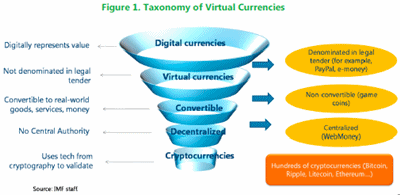
The orange 'Cryptocurrencies' box in the lower right says,

Hundreds of cryptocurrencies (Bitcoin, Ripple, Litecoin, Ethereum, ...)

And here is an outline of the table of contents.

  5 EXECUTIVE SUMMARY
  6 INTRODUCTION
  6 A. Overview
  7 B. What are Virtual Currencies?
10 ARE VIRTUAL CURRENCIES MONEY?
11 A. Perspectives from Theory and History
16 B. Legal Perspectives
17 C. Economic Perspectives
18 DISTRIBUTED LEDGERS
18 A. What Are They and How Do They Work?
21 B. Emerging Uses of Distributed Ledgers
24 REGULATORY AND POLICY CHALLENGES
24 A. Regulatory Challenges and Responses
27 B. Financial Integrity: AML/CFT
28 C. Consumer Protection
30 D. Taxation
31 E. Exchange Controls and Capital Flow Management
31 F. Financial Stability
33 G. Monetary Policy
35 THE WAY FORWARD
38 SELECTED BIBLIOGRAPHY

Better than the 'EXECUTIVE SUMMARY' (p.5) is the 'INTRODUCTION' (p.6). Here are the bullets minus their explanations.

INTRODUCTION • A. Overview

1. New technologies are driving transformational changes in the global economy, including in how goods, services, and assets are exchanged.

2. An important development in this process of transformation has been the emergence of virtual currencies (VCs).

3. VCs and their underlying distributed ledger technologies have the potential to generate benefits.

4. However, these technologies also pose risks.

5. Any policy response to VCs will need to strike an appropriate balance between forcefully addressing risks and abuses while avoiding overregulation that could stifle innovation.

6. This paper discusses the potential benefits and risks posed by VCs and how financial regulators could approach them.

7. As a starting point, it is important to note that the VC landscape is still new and rapidly changing.

I know the document wouldn't go over well with the 'let's-have-anarchy' crowd, but I found it useful for understanding the current issues facing bitcoin++.
20 February 2016

Bitcoin in the News : 2016-01 Davos

In the previous post, Bitcoin in the News : 2016-01 More++, I mentioned,
Another source of news was the annual World Economic Forum, Davos, Switzerland. The Davos stories might be worth a separate, deeper look.

For starters, here's a video from the event.


Davos 2016 - The Transformation of Finance (55:54) • 'What trends and uncertainties are shaping the future of financial services?'

The corresponding Youtube page lists the speakers as John Cryan, James P. Gorman, Christine Lagarde, Dan Schulman, and Tom de Swaan; the moderator as Gillian R. Tett. See that page (right click the video) for their titles and functions.

At about 5:40 into the clip, the IMF's Lagarde holds up a print copy of 'Virtual Currencies and Beyond : Initial Considerations'. For more about it, see Publication Date: January 20, 2016 (imf.org), with a link to a PDF version.

13 February 2016

Bitcoin in the News : 2016-01 More++

After Bitcoin in the News : 2016-01 Predictions, let's look at some of the other bitcoin stories that were reported in January. The most-repeated news item was about a central bitcoin figure named Mike Hearn.

Another item was about an up-and-coming company named Digital Asset Holdings.

Both New York Times stories (nytimes.com) were by Nathaniel Popper, writing for NYT's DealBook. Popper is the author of 'Digital Gold: Bitcoin and the Inside Story of the Misfits and Millionaires Trying to Reinvent Money' (Harper, 2015), a top-10 seller in Amazon's Books > Business & Money > Economics > Digital Currencies.

Another source of news was the annual World Economic Forum, Davos, Switzerland. The Davos stories might be worth a separate, deeper look.

Among the other two dozen reports on my short list, several were about bitcoin's dark side, a favorite topic of mainstream news sources.

The previous post, 'Predictions', noted that bitcoin's reputation needs to be improved. In none of the headlines above is there much that indicates it is going to happen soon.

06 February 2016

Bitcoin in the News : 2016-01 Predictions

My previous 'In the News', Bitcoin in the News : 2015-12, noted that December was 'the month when [journalists] look forward to imagine what the coming year will bring'. I could say the same for January. Here is a summary of predictions.

What's Next for Bitcoin in 2016 (fortune.com):-

The bear case: 1. Reputation. 2. Still no killer app. 3. Startups shut down • The bull case: 1. Stability. 2. Blockchain. 3. Record-high VC money. • The bottom line: There are stronger arguments in favor of bitcoin in 2016 than against it.

5 Big Questions for Bitcoin Growth in 2016 (fxstreet.com):-

1. How will scalability be solved?
2. Will reward halving affect price?
3. Will bitcoin platforms attract developers?
4. Will we see a killer app?
5. Will we see autonomous transactions?

4 Trends That Will Shape Bitcoin Regulation in 2016 (coindesk.com):-

1. Policing of onramps and offramps
2. Spotlight on terror financing
3. Scrutiny of blockchain applications
4. Bitcoin's reputation improved

Thought Bitcoin Was Dead? 2016 Is the Year It Goes Big (wired.com):-

As Coinbase’s Adam White sees it, 2015 was the year that the blockchain moved beyond digital currency. Many observers saw this as bitcoin’s "great pivot" -- where its true purpose moved away from online money. But White believes that 2016 is the year the pundits realize that the digital currency can still change the world.

"We’re going to come full circle back to bitcoin," he says. "In 2015, we saw a lot of financial institutions, banks, thought leaders say: ‘It’s not about bitcoin, it’s about blockchain.’ That is a mistruth."

2015 Was Do or Die for Bitcoin Miners But Promise Lies Ahead (coindesk.com again):-

Just as in 2014, we saw attrition in mining operations (and among manufacturers) – the less favorable economic conditions meant many were unable to survive. The explosion of hashrate coming from China eclipsed operations in other parts of the world, and we quickly found the conditions at which many operations had to 'blink first'.

[The Challenges:] First-mover (dis)advantage; Nobody loves bitcoin; Block-size debate; Optimizing expenses; Competition at industrial scale; Corporate integration

7 Emerging Trends For Bitcoin and the Blockchain (coindesk.com for the third time):-

1. Blockchain apps will be released
2. Regulatory scrutiny of applications will increase
3. Bitcoin the currency will continue to grow
4. Interest in use cases outside payments will pick up
5. Bitcoin's price will continue its recent rally through 2016
6. Consortia will prove to be important
7. VC money will flow to blockchain startups

Looks like my bitcoin blogging is on the right track. I know what the experts are talking about, even if I couldn't have put a list together myself. For my next 'In the News : 2016-01' post, I'll look at the other stories from January.