Showing posts with label Photos. Show all posts

15 May 2021

Working on Resourcefulness

Another month of five Saturdays gives me another opportunity for an extra blog post. The last time this happened, Bitcoin in the News : 2020 Full Year (January 2021), I wrote,
I'd like to get rid of that twirly effect when a new page is opened. It's really annoying. I've looked at the blog template several times and haven't been able to determine the cause. Maybe I should simply change the template.

I tried many of the alternative templates and most -- Not all! Why not? -- also produced the 'twirly effect'. While I was working on that, I tried a number of other browsers and noticed that they didn't twirl. Is it a Firefox issue? If so, it might be related to responsive design; maybe it's trying to find the current orientation of the screen. While I didn't solve the problem, I did manage to understand it better.

Since that doesn't make much of a post, I also reviewed the widgets on the right sidebar. First I added a link for the recent Coinbase listing on NASDAQ. A good explanation is in Coinbase IPO: Here’s What You Need To Know (forbes.com; April 2021). Then I cleaned up some of the other widgets. The 'Blog List' widget isn't working very well, but I'm not sure why. If I ever come back to it, a useful reference might be Top 100 Bitcoin RSS Feeds (feedspot.com).

***

This image from one of my chess blogs is worth mentioning here. Follow the link for details about the source of the photo (Ivan Radic on Flickr).
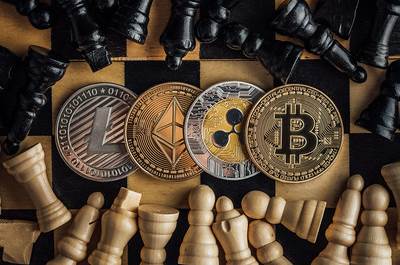

Four Faces of Crypto Currency
(Chess for All Ages; May 2021)

31 December 2016

Bitcoin New Year

A week ago I had an easy post with Bitcoin Christmas (24 December 2016), and today I have another easy post.


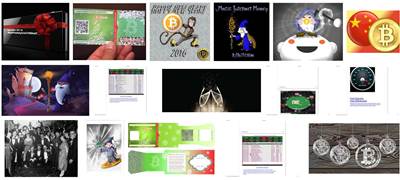
Google image search on 'bitcoin "new years"'

Three of the images -- the fourth & fifth on the first line and the first on the second line -- are from the same source: Winners of the New Years Bitcoin Wizard Art Contest (January 2014):-

I wish I had more money to give out, because there were so many awesome entries in this contest.

I've been doing this bitcoin blog for a year and a half, since First Post, New Blog (4 July 2015). I've taken it as far as I need and will be cutting back to two posts a month, mainly to keep up with any news.

Have a Happy 2017!

24 December 2016

Bitcoin Christmas

A year ago my weekly bitcoin post fell on Boxing Day, so I had Bitcoin Boxing the Dollar (December 2015). This year it falls on Christmas Eve, so I'll just have a simple post celebrating Christianity's favorite holiday. Bitcoins wearing stocking hats and serving as ornaments it will be.


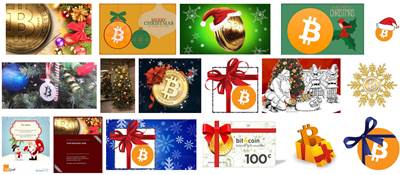
Google image search on 'bitcoin christmas'

A week ago I documented the bitcoin price in Buying Ethereum, making it easy to observe that the price is up nearly 20% in the seven days since then. I'm sure we'll see all sorts of reasons for the rise when I look at December news, but that's the sort of price rise you only see in a pyramid scheme. Take it as the gift it is and enjoy it while it lasts.

Have a Merry Christmas and please drive safely!

27 August 2016

Blockchain Metadata

I have time for one post before I have to get back to this month's news. Let's continue with Bitcoin at Princeton, where the last post was Core Developers (June 2016):-
While working through the lectures, I've noted a few topics worth pursuing on this blog.

The next lecture topic I noted is 'Bitcoins as "Smart Property"', which is covered in section 9.2 of the course textbook:-

Now we’ll talk about using bitcoins to represent something other than a unit of currency in the Bitcoin system. [...]

Fungibility: This also leads to an interesting observation: bitcoins aren't fungible. In economics, a fungible good is one where all individual units are equivalent and can be substituted for one another. For example, gold is fungible since one ounce of (pure) gold can be substituted for any other ounce of gold. But this isn’t always true of Bitcoin because every bitcoin is unique and has a different history. [...]

Smart Property: Could this non-fungibility property be useful? We’ve already seen why it can be bad for privacy because of the potential for deanonymizing users. In this section we’ll look at why it can also be useful to give meaning to the history of a bitcoin.

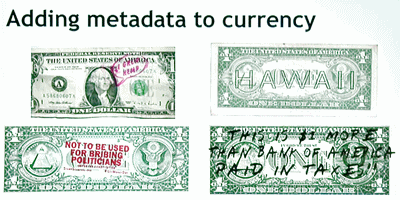
The clever example to illustrate this topic is 'writing on currency'. A few examples were given in the corresponding lecture.


Left to right, top to bottom:
'I [George Washington] grew hemp'
'HAWAII'
'Not to be used for bribing politicians'
'This is $1 more than Bank of America paid in taxes!'

The textbook explains,

Let's think about what it would mean to give meaning to the history of ordinary offline physical currency. Suppose we wanted to add metadata to offline currency. In fact, some people already do this. For example, they like to write various messages on banknotes, often as a joke or a political protest. This generally doesn’t affect the value of the banknote, and is just a novelty.

I wasn't sure about the legality of this, but Yes, It's Legal! (stampstampede.org):-

Many people assume that it’s illegal to stamp or write on paper currency, but that’s not the case. It’s illegal to destroy paper currency or deface it so much that it’s no longer recognizable and has to be taken out of circulation.

That is not the case in the examples shown above. Back to bitcoin and the Princeton text:-

But what if we could have authenticated metadata attached to our currency -- metadata that cannot easily be duplicated? One way to achieve this is to include a cryptographic signature in the metadata we write, and tie this metadata to the serial number of the banknote.

And that opens the blockchain to a new universe of potential uses. I'll explore these in another post.

25 June 2016

Stores of Value

The previous post mentioned, 'While working through [bitcoin] lectures, I've noted a few topics worth pursuing on this blog. The first is' Core Developers. The second should have been this current post, but I'm taking a short detour because of the excitement and chaos provoked by Brexit, aka United Kingdom withdrawal from the European Union (wikipedia.org).
The UK electorate again addressed the question on 23 June 2016, in a referendum on the country's membership. This referendum was arranged by Parliament when it passed the European Union Referendum Act 2015. The result of this referendum held in June 2016 was 51.9% in support of an exit (17,410,742 votes) and 48.1% (16,141,241 votes) to remain.

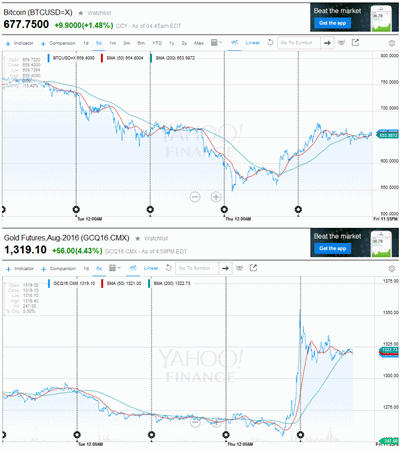
On a whim, I looked at 'bitcoin brexit', and discovered that the bitcoin price spiked as the result of the vote became known. Since the price of gold also spiked, I wondered if there was any correlation. The following charts, from finance.yahoo.com, show the price action in both commodities over the last week.

Bitcoin (BTCUSD=X)

Gold Futures,Aug-2016

Although other factors were moving the price of bitcoin on the days before the vote, the Brexit result moved the price over the next hours before finding an equilibrium. Bitcoin enthusiasts like to promote the crypto-currency as a stable Store of value (wikipedia.org again)...

A store of value is the function of an asset that can be saved, retrieved and exchanged at a later time, and be predictably useful when retrieved. The most common store of value in modern times has been money, currency, or a commodity like gold, or financial capital. The point of any store of value is risk management due to a stable demand for the underlying asset.

...but is it really? One point of view is Bitcoin as a Store of Value, Unit of Account, and Medium of Exchange (nakamotoinstitute.org), illustrated with a picture of King Kong.

18 June 2016

Core Developers

While continuing to follow the Online Bitcoin Course (started March 2016), I received a message from the domain hosting the course.
In 2014, Coursera began developing a new technology platform to improve your learning experience, and to allow courses to run more frequently. The majority of our courses are now offered on the new platform. This month, we are closing the old platform. One or more courses you joined are on the old platform. Effective June 30, 2016, courses on the old platform will no longer be available. You should use this opportunity to save any relevant course materials or assignments.

That meant I had to finish the course by the end of this month. I'm already on the last lecture -- 'Lecture 11: The Future of Bitcoin' -- with only a 'bonus' lecture to follow, so I should finish in time. In any case, the last lectures are somewhat less interesting than the first, as they deal with topics that are mainly of interest to the academic community.

While working through the lectures, I've noted a few topics worth pursuing on this blog. The first is shown below.


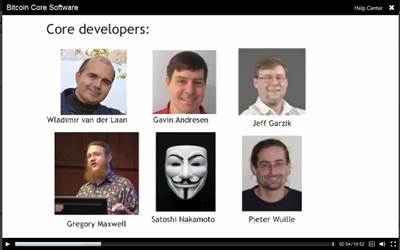
Lecture 7.2 - Bitcoin core software (3:00)

Pictured are a handful of core developers at the time the course was created, around mid-2014. While researching this post, I discovered that the term 'bitcoin core developers' means different things to different people. Exluding Satoshi Nakamoto, the other five are listed on the page Bitcoin Development (bitcoin.org), under 'Bitcoin Core contributors (ordered by number of commits)'. Their names, along with the number of results returned by a Google search are as follows:-

  • Wladimir van der Laan (10.800 results)
  • Gavin Andresen (107.000)
  • Jeff Garzik (42.700)
  • Gregory Maxwell (84.700)
  • Pieter Wuille (16.900)

A Reddit.com discussion appeared this week titled A thank you to Bitcoin Core developers. Although it's largely political, as is much of the noise around bitcoin, it's a sentiment shared by many.

28 May 2016

Bitcoin Deanonymization

How's it going with that 'online bitcoin course', last mentioned in Going Deeper into Bitcoin (March 2016)? At that time I wrote,
It took me exactly a week to work through the first two lectures. I'm sure that I won't be able to maintain this pace week after week, and I only skimmed the readings.

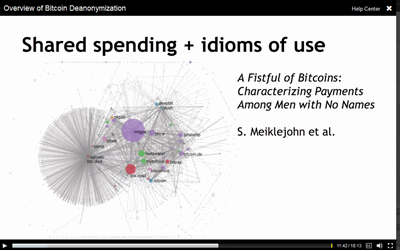
I've reached lecture six where I found an interesting image in '6.2 Overview of Bitcoin Deanonymization'. At about 11:40 into the video, the following chart is shown.

A similar chart can be found in the paper A Fistful of Bitcoins: Characterizing Payments Among Men with No Names Sarah Meiklejohn et al. The caption there (p.9) says,

Figure 6: A visualization of the user network. The area of the cluster represents the external incoming value; i.e., the bitcoins received from other clusters but not itself, and for an edge to appear between two nodes there must have been at least 200 transactions between them. The nodes are colored by category: blue nodes are mining pools; orange are fixed-rate exchanges; green are wallets; red are vendors; purple are (bank) exchanges; brown are gambling; pink are investment schemes; and grey are uncategorized.

Also interesting -- to me, at least -- are the 16 bitcoin services listed in the chart:-

bitcoin.de, bitcoinica, bitmit, bitpay, bitstamp, btc-e, deepbit, gibse, instawallet, mtgox, mybitcoin, okpay, ozcoin, satoshi btc dice, silk road, slush

Since few of those are household names, I'll look at them in another post.

27 February 2016

IMF: 'Virtual Currencies and Beyond'

In my previous post, Bitcoin in the News : 2016-01 Davos, I fetaured a video where, at one point,
The IMF's Lagarde holds up a print copy of 'Virtual Currencies and Beyond : Initial Considerations'.

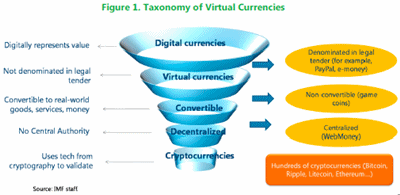
Using the link given in that same post, I downloaded a copy of the document, loaded it onto my Kindle, and spent an hour studying its content. Here is a useful graphic (p.8) explaining the term 'Virtual Currencies'.

The orange 'Cryptocurrencies' box in the lower right says,

Hundreds of cryptocurrencies (Bitcoin, Ripple, Litecoin, Ethereum, ...)

And here is an outline of the table of contents.

  5 EXECUTIVE SUMMARY
  6 INTRODUCTION
  6 A. Overview
  7 B. What are Virtual Currencies?
10 ARE VIRTUAL CURRENCIES MONEY?
11 A. Perspectives from Theory and History
16 B. Legal Perspectives
17 C. Economic Perspectives
18 DISTRIBUTED LEDGERS
18 A. What Are They and How Do They Work?
21 B. Emerging Uses of Distributed Ledgers
24 REGULATORY AND POLICY CHALLENGES
24 A. Regulatory Challenges and Responses
27 B. Financial Integrity: AML/CFT
28 C. Consumer Protection
30 D. Taxation
31 E. Exchange Controls and Capital Flow Management
31 F. Financial Stability
33 G. Monetary Policy
35 THE WAY FORWARD
38 SELECTED BIBLIOGRAPHY

Better than the 'EXECUTIVE SUMMARY' (p.5) is the 'INTRODUCTION' (p.6). Here are the bullets minus their explanations.

INTRODUCTION • A. Overview

1. New technologies are driving transformational changes in the global economy, including in how goods, services, and assets are exchanged.

2. An important development in this process of transformation has been the emergence of virtual currencies (VCs).

3. VCs and their underlying distributed ledger technologies have the potential to generate benefits.

4. However, these technologies also pose risks.

5. Any policy response to VCs will need to strike an appropriate balance between forcefully addressing risks and abuses while avoiding overregulation that could stifle innovation.

6. This paper discusses the potential benefits and risks posed by VCs and how financial regulators could approach them.

7. As a starting point, it is important to note that the VC landscape is still new and rapidly changing.

I know the document wouldn't go over well with the 'let's-have-anarchy' crowd, but I found it useful for understanding the current issues facing bitcoin++.

30 January 2016

This Page Sort of Left Blank

For this post, I wanted to follow-up Sourcing Bitcoin, and investigate the question 'How do you do proper accounting using bitcoin?'. Unfortunately I came down with a bad cold and the accounting concepts were too much for my poor brain to handle. I'll close with an appropriate image.


'If you want to use Cointelegraph.com artwork on your site...'

26 December 2015

Bitcoin Boxing the Dollar

Today, being both the day after Christmas and a Saturday, is not a day to work, so let's have an easy post. How about a composite image as in the Halloween post Bitcoin : Trick -or- Treat? (31 October 2015).

Sure, that might work, except it's not really Christmas -- it's the day after -- so the moment has passed for a Christmas post. How about a Boxing Day post as in Boxing Day [Wikipedia]:-

Boxing Day is a holiday traditionally celebrated the day following Christmas Day, when servants and tradesmen would receive gifts, known as a "Christmas box", from their masters, employers or customers. [...] In the liturgical kalendar of Western Christianity, the day is dedicated to St. Stephen, so is known as St. Stephen's Day to Christians (especially Anglicans, Lutherans and Roman Catholics), and to the population generally in Italy, Ireland, Finland, Alsace and Moselle in France. It is also known as both St. Stephen's Day and the Day of the Wren or Wren Day in Ireland. In some European countries, most notably Germany, Poland, the Netherlands and those in Scandinavia, 26 December is celebrated as the Second Christmas Day.

Since I didn't know any of that, I'm now a little more knowledgeable. An image search on 'bitcoin boxing' brings up mostly Mike Tyson photos, as in Boxing Legend Mike Tyson Launching Bitcoin ATM. Exclude the word 'Tyson' and voila...


Google image search on 'bitcoin boxing -tyson'
(Sorry, Mike!)

For me, the most interesting images in the composite are the cartoons. The T-shirt (and the related cartoon next to it) in the top row goes to Bitcoin vs Money Boxing Fight Retro Design T-Shirt:-

The Greatest Fight in History
World Currency Championship Fight
BITCOIN Challenger vs. FIAT MONEY Champion
* Ringside is where it's at * No home TV * No radio *

The image to the left of the second row goes to Bitcoin Stock Vector [dreamstime.com], captioned 'Bitcoin is boxing with dollar'. Dreamstime it is; a drawing depicting David vs. Goliath would be more realistic. What will next Christmas bring for bitcoin?

28 November 2015

Bitcoin Mining Farm - Electricity

In my previous post, Bitcoin Mining Farm, I quoted Eric Mu, the brain behind the bitcointalk.org thread, saying,
Using cheap hydro-power and low-cost water-cooling system, this farm has achieved high ROI rate.

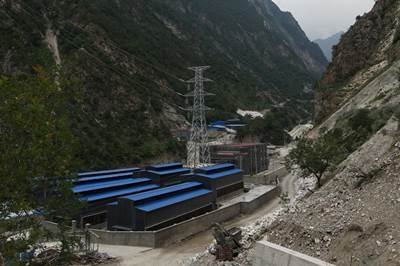
That one sentence pinpoints an essential aspect of the business model: cheap electricity. The following photo shows the bitcoin farm (blue roofs) colocated with a hydropower plant (red roof) in western China.


Multi-petahash BTC mine in Kangding, Sichuan, China (p.21)

Following are selected quotes from the thread, all discussing the importance of cheap electricity.

p.1

The equipment is actually relocated - the new location has cheaper electrical rate so it makes sense to relocate. We would have bought new ones but the supply has been tight and we deem the prices for the new ones are too high.

p.4

The electricity price in the new site is 43% cheaper than the previous one that we relocated from; the downside is that we will have to invest about RMB 4 million in the infrastructure. While the facility right now is filled with old machines of our own (about 5.3P), we have two warehouses under construction and are also looking to buy 6P worth of secondhand miners.

p.11

As some of you already know, I had been traveling. Right now I'm writing from my hotel room in Dalad Banner, a county-level administration in Inner Mongolia with a population of 0.34 million (according to Baidu Zhidao, the Chinese Wikipedia ). [...] The bus ride took 10 hours to bring us from the nameless valley we are located in to Chengdu. We arrived in late evening. We stayed in Chengdu that night and boarded the airliner from Chengdu to Hohhot the next morning. [...]

In the middle of nowhere, we saw this mammoth mine - I was told that it consumed half of the electricity the rest of the county collectively uses. Though I can't verify its claim being Asia's largest, it is obviously larger than ours in Kangding. But the thing is that the electricity that was regarded cheap a couple years ago, was no longer when compared with the newly discovered western Sichuan hydropower, so don't be surprised that it will be emptied over the next few months.

p.15

One caveat of relying on hydropower is that in winter, the supply is likely to be limited. • Q: Can you elaborate on why the hydropower would be limited in the winter? Something freezing somewhere? Electricity needed elsewhere? [...] Most likely the water freezes during the winter so the flow to the hydro station is substantially reduced. • A: More to do with the local precipitation pattern than temperature. We have been thinking of building mobile mines that can be towed by trucks like trailers.

p.16

[Quoting an external source] In spite of the a bright picture painted by the central government's "One Belt And One Road" plan for China's hydropower future, in parts of the country, imbalance of electricity consumption and development remains. Large amount of hydropower is "wasted", new projects are getting increasingly technically challenging, and the resettlement are becoming more and more costly – all threatening the healthy development of the industry.

Near the end of the thread, Eric Mu says, 'the total hashrate will eventually stabilize at 21 to 25 P'. That takes a lot of electricity.

21 November 2015

Bitcoin Mining Farm

Posting about bitcoin once a week gives me a regular opportunity to look into different aspects of the subject. One of the most interesting resources so far is on the 'Bitcoin Forum' (bitcointalk.org; see the navigation sidebar on the right): Three months living in a multi-petahash BTC mine in Kangding, Sichuan, China. The blog-like thread was maintained by Eric Mu, CMO of HaoBTC.
I have embarked on a three-month project working and living in a BTC mining farm located in the mountainous region of western Sichuan province. Using cheap hydro-power and low-cost water-cooling system, this farm has achieved high ROI rate. Right now it generates 4.7 petahash/sec and according to our plan will max at 12P over the next three to four months period.

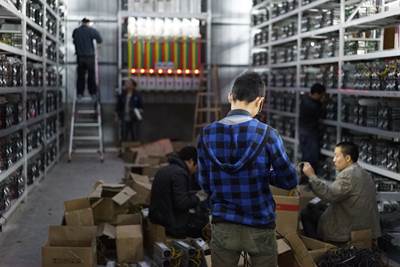
CMO stands for 'Chief Marketing Officer' and HaoBTC 'provides innovative and well-rounded solutions for global Bitcoin users and investors' according to haobtc.com. The forum thread is full of photos like the following.

Vocabulary - Bitcoin [bitcoin.org] informs,

Hash Rate - The hash rate is the measuring unit of the processing power of the bitcoin network. The bitcoin network must make intensive mathematical operations for security purposes. When the network reached a hash rate of 10 Th/s, it meant it could make 10 trillion calculations per second.

For more, see What does One Petahash look like?; 'An Asicminer Blade is 10GH, so 1 PH is 100,000 of these.' For more from Eric Mu, see My Life Inside a Remote Chinese Bitcoin Mine [coindesk.com].

31 October 2015

Bitcoin : Trick -or- Treat?

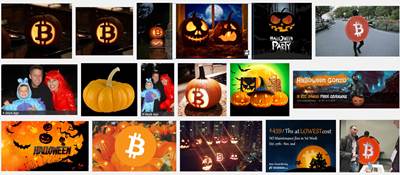
Since it's Halloween today, let's take a short break from the thread last seen on It's for Speculating, Not Buying Stuff, and look at the following composite image. Is there anything to take away here?


Google image search on 'bitcoin halloween'

Jack-o-lanterns top row, left: I'm not sure who gets the credit as creator for this image -- it's a clever carving -- so let's take the one on a bitcoin domain. Bitcoin; Carving Out History! (31 October 2013, BitcoinNe.ws); 'Finishing up October with a treat, bitcoin remains over $200 on popular exchange Mt Gox which is a ~66% increase since the 1st.'

Costumed family pictured twice in the second row, left: Bitcoin Takes on a Scary New Look for Halloween; 'Online Halloween costume store Halloween Nation asks customers to pay with Bitcoin and Paypal instead of credit cards.'

Jack-o-lantern second row, center: BitClub Network International on Pinterest; 'BitClub Network International : A Global Wealth Building Company for the Digital Currency Market. The most innovative & lucrative way to earn digital currency. Join BitClub today!'

Jack-o-lantern group picture bottom row, center: When, Not If: Bitcoin in Israel; 'Have you seen Coinapult’s pumpkins for this year?'

That last reference mentions 'Bitcoin 2.0 technology'. I wonder what that means.