07 January 2017

Bitcoin in the News : 2016-12 Price

The big bitcoin news of the last month of 2016 was a massive price rise. I counted four stories from one source alone (Business Insider : uk.businessinsider.com).

2016-12-22: Bitcoin is surging

The price of digital currency bitcoin continues to surge on Thursday, up over 5% against the dollar by mid-morning in London. The digital currency broke through $800 a bitcoin on Wednesday and ended the day at $826.29.

2016-12-27: Bitcoin is soaring

Bitcoin is soaring as traders return to work after the extended Christmas break. The cryptocurrency is trading up 3% to more than $929 and is at its best level in three years.

2016-12-28: Bitcoin is still storming higher

Bitcoin's incredible rally continues on Wednesday, up close to 3% against the dollar in early trade in London. The digital currency is up 2.8% to $958.52. Bitcoin has shot up over $150 over the last week, with little obvious spur for the price rise. Bitcoin is now at its highest level since November 2013 when it reached $1000.

2016-12-30: China is behind the latest bitcoin craze

Bitcoin had a great 2016. The cryptocurrency rallied 120% to $952, threatening to break the $1,000 mark for the first time since 2013. While bitcoin has seen a consistent bid throughout the year, its 57% gain (in US dollar terms) over the past three months has been particularly impressive. • So what's behind the move? • China.

China is as good a guess as any, but it's still just a guess. The last time I did a post in price action was Bitcoin in the News : 2016-06 Price (July 2016). Like so many Yahoo services, the charting service I used for that post has declined in quality. Here's what I get now for the month of December.
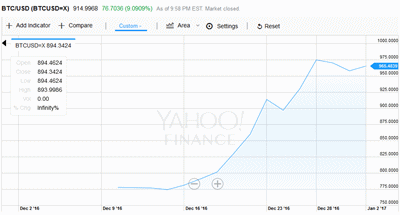

BTCUSD=X Interactive Stock Chart - Yahoo Finance

Prices before 12 December (which gives BTC = 778 USD) are marked 'N/A'. The peak for the month shows about 975 USD. Since the end of December, the price has come down considerably, but I'll look at that in the news for January 2017.


31 December 2016

Bitcoin New Year

A week ago I had an easy post with Bitcoin Christmas (24 December 2016), and today I have another easy post.


Google image search on 'bitcoin "new years"'

Three of the images -- the fourth & fifth on the first line and the first on the second line -- are from the same source: Winners of the New Years Bitcoin Wizard Art Contest (January 2014):-

I wish I had more money to give out, because there were so many awesome entries in this contest.

I've been doing this bitcoin blog for a year and a half, since First Post, New Blog (4 July 2015). I've taken it as far as I need and will be cutting back to two posts a month, mainly to keep up with any news.

Have a Happy 2017!

24 December 2016

Bitcoin Christmas

A year ago my weekly bitcoin post fell on Boxing Day, so I had Bitcoin Boxing the Dollar (December 2015). This year it falls on Christmas Eve, so I'll just have a simple post celebrating Christianity's favorite holiday. Bitcoins wearing stocking hats and serving as ornaments it will be.


Google image search on 'bitcoin christmas'

A week ago I documented the bitcoin price in Buying Ethereum, making it easy to observe that the price is up nearly 20% in the seven days since then. I'm sure we'll see all sorts of reasons for the rise when I look at December news, but that's the sort of price rise you only see in a pyramid scheme. Take it as the gift it is and enjoy it while it lasts.

Have a Merry Christmas and please drive safely!

17 December 2016

Buying Ethereum

It's been almost 16 months since I bought my first bitcoins, a process I documented in three consecutive posts (August 2015):-

One of the advantages of that transaction has been to become familiar with Coinbase, the service that holds my account ('wallet' in cryptocurrency jargon). They send me occasional emails informing me about new features. For example, during the last few months I learned:-

The Ethereum announcement in July caught my full attention. After a few posts touching on the subject...

...I felt I had sufficient knowledge to buy a small quantity. I signed on to Coinbase (always an irritating three-step process: password, SMS code, email link), discovered that I needed a fiat currency (Euros in my case) to buy anything, sold half of my bitcoin, and bought an equivalent amount of ethereum (NB: lower case, to be consistent). Coinbase charged a 1.5% commission on both sides of the transaction.

After the second transaction, Coinbase showed that I still had all of the Euros in my account. I thought about trying a double spend to see what would happen, but decided that I didn't want to risk getting a black star next to my name.

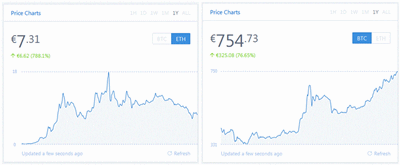
The Coinbase account overview gives a price history of the currencies. Here's a comparison of the two currencies over the past year. Did I exchange a winner for a loser?


Left: ETH; Right: BTC

In my previous post, Bitcoin in the News : 2016-11 More++, I noted, 'It sounds like every purchase with bitcoin might trigger a corresponding capital gain/loss'. If this is the case when I sold half of my bitcoin (a small amount) to prepare the ethereum purchase, the accounting is going to be awkward.

10 December 2016

Bitcoin in the News : 2016-11 More++

Even though my previous post, Bitcoin in the News : 2016-11 Election, had more than enough bitcoin news for a single month, there were a few other stories worth mentioning. The most important of these was the subject of a New York Times article by Nathaniel Popper, which automatically confirms its importance:-
  • 2016-11-18: Bitcoin Users Who Evade Taxes Are Sought by the I.R.S. (nytimes.com) • 'The tax agency sent a broad request on Thursday to Coinbase, the largest Bitcoin exchange in the United States, asking for the records of all customers who bought virtual currency from the company from 2013 to 2015. '

I took away two points from this. Bitcoin transactions (1) are subject to capital gain treatment, and (2) can be used for 'creative' financial manipulation. The NYT article noted,

The basic tax rules for Bitcoin users were set down by the I.R.S. in 2014. The agency’s guidance said that people should treat their virtual currency as property, rather than currency, for tax purposes. [...; An I.R.S. agent] identified two companies that were buying Bitcoin and misreporting them with the I.R.S. as technology expenses.

For more angles on the IRS and Coinbase, see Google's related stories:-

An unrelated story underscored another point of friction between sovereign governments and bitcoin:-

  • 2016-11-03: Chinese Government To Force Capital Controls On Bitcoin Exchanges (newsbtc.com) • 'Local exchanges will deal with limitations regarding the amount of funds moving outside of the country. Additionally, the government also wants to cap the number of Bitcoins sent abroad. Neither of these scenarios can be enforced, though, as no one can exert control over Bitcoin.'

China featured in another pair of stories from the same source and writer:-

Is China the defacto capital of the bitcoin world? With yearend arriving even faster than usual, I'm ready for another round of retrospective opinion pieces like this one:-

As for buying non-illicit stuff, here are two stories on the current state of affairs:-

  • 2016-11-22: iPayYou Brings Bitcoin To Amazon (pymnts.com) • 'Bitcoin wallet iPayYou continues to work toward a future with bitcoin as the default currency. It was just announced that iPayYou has made a way for consumers to pay for items on Amazon with bitcoin, called Amazon Direct.'
  • 2016-11-25: Bitcoin Black Friday Deals for the Digital Currency Enthusiast (nasdaq.com) • 'Here are a few options for anyone looking to get a good deal on some crypto-friendly merchandise this weekend. • Hardware Wallets • OpenBazaar Stores and Other Specialty Sites'

Getting back to that first story, the IRS and Coinbase, it sounds like every purchase with bitcoin might trigger a corresponding capital gain/loss. What am I missing?

03 December 2016

Bitcoin in the News : 2016-11 Election

Bitcoin news last month was dominated by the U.S. presidential election results (as was most news in general). The victory of Donald J. Trump over Hillary Clinton reminded many observers of the unforeseen, populist result of the Brexit vote near the end of June. At that time I wrote two posts -- Stores of Value (25 June 2016) and Bitcoin in the News : 2016-06 Price (02 July 2016) -- both of which could serve as templates for the current post-election analysis.

News stories for November followed a predictable pattern. First there was the pre-election prognostication.

Then there was the immediate reaction to the unexpected result. There were so many stories that Google News offered 'Full Coverage'. Here is their main story followed by the related stories.

In June I wrote about 'store of value'; here we have 'safe haven'. Are they the same thing or is there a subtle distinction? Whatever the answer, the following days brought more reflective stories.

This morphed into another round of 'Full Coverage'.

After a few weeks there was anecdotal analysis of the new reality: Trump would soon be U.S. President.

As for the post-election price bumps, I was surprised to find a number of reasons offered by the pundits. Here are contradictory views from the period 2016-11-09 Full coverage:-

  • 2016-11-09: Cryptocurrencies rise on Trump victory (techcrunch.com) • 'What’s clear is that when politics defies conventional expectation, and when very many best laid plans are laid to wrack and ruin, cryptocurrencies are acting as a haven and a hedge against uncertain times -- alongside the traditional one: gold.'

  • 2016-11-09: The Trump Train Goes to Washington; Three Ways Trump Helps Bitcoin • '[Trump has] already done more in one night than President Obama has done in eight years. Thank you America, for joining me and the rest of the liberty movement on the right side of history.'

That first sentence of 'Trump Train' shows that the rest of the opinion piece is not exactly thoughtful analysis. What are the 'Three Ways Trump Helps Bitcoin'?

  • 'Bitcoin price should go up even faster for the rest of the year'
  • 'Not having World War III should be good for Bitcoin'
  • 'Choosing the right President protects the Internet and Bitcoin'

'Not having World War III' should be good for just about everything and not everyone agrees that Trump is the 'right President', but Americans do have freedom of expression ... at least for now.

26 November 2016

Shor's Algorithm

Although my previous post, Quantum Computers, was only a low level introduction to the subject, it piqued my interest. I ended that post with a vague objective for a follow-up:-
In my next post I'll try to learn more about quantum algorithms.

I continued watching videos and quickly discovered that the algorithm with a direct impact on bitcoin is Shor's algorithm (Wikipedia):-

Shor's algorithm, named after mathematician Peter Shor, is a quantum algorithm (an algorithm that runs on a quantum computer) for integer factorization formulated in 1994. Informally it solves the following problem: given an integer N, find its prime factors. On a quantum computer, to factor an integer N, Shor's algorithm runs in polynomial time (the time taken is polynomial in log N, which is the size of the input).

Next I found a short video on Youtube starring Peter Shor, What is Shor's factoring algorithm?, but it's much too short to explain the subject properly. Another video, Shor's Algorithm, looked more promising, but required knowledge of math concepts that I wasn't familiar with. Fortunately, it was the last clip in a course playlist, Intro to Quantum Computing (no.23/23), that covered the math from the start. From the first videos in the course, I learned that quantum mechanics are based on linear algebra, a subject I studied many years ago when I was still capable of learning complicated new things.

Although I wasn't able to complete the intro course before writing this post, I found another video that explained the algorithm using more basic math. After one full viewing, I can't say that I've grasped it completely, but I'll watch it a few more times until it sinks in.


44 Quantum factoring : Shor's factoring algorithm (25:42) • 'Quantum Mechanics and Quantum Computation'

The Youtube page for that clip says, 'Published on Nov 26, 2016', which is the date on this current post. (How lucky is that?) It's part of another course playlist, Quantum Mechanics and Quantum Computation, that currently stops at '43 Quantum factoring : Period finding', so I assume it will be updated wth the new clip(s) in due time.

From all of this it looks like the cryptographic underpinnings of bitcoin might indeed be at risk in the not-too-distant future, especially if there is an equivalent of Moore's law that applies to quantum computer hardware. Not to worry too much, because Quantum cryptography (Wikipedia) promises a parallel evolution:-

Quantum cryptography is the science of exploiting quantum mechanical properties to perform cryptographic tasks. The best known example of quantum cryptography is quantum key distribution which offers an information-theoretically secure solution to the key exchange problem. Currently used popular public-key encryption and signature schemes (e.g., RSA and ElGamal) can be broken by quantum adversaries. The advantage of quantum cryptography lies in the fact that it allows the completion of various cryptographic tasks that are proven or conjectured to be impossible using only classical (i.e. non-quantum) communication.

With all of that in mind, I'll continue any further investigation of the quantum world outside the confines of this blog. After two posts on a quantum detour, I'm ready to return to the main subject: bitcoin.