19 December 2015

Bitcoin in the News - Oct/Nov 2015

Continuing to catch up with news that has been reported since I started this blog, let's look at the two full months following Bitcoin in the News - Q3 2015. In both months there was one story that stood out above the others.

October:

November:

A useful graph showing recent bitcoin price movements can be found at Bitcoin Price Index Chart (coindesk.com).

Another story that garnered attention was EU clamps down on bitcoin, anonymous payments to curb terrorism funding (reuters.com). Negative stories on bitcoin are nothing exceptional, e.g. Ben Bernanke: Bitcoin Has 'Serious Problems'. It's worth paying attention when a former Federal Reserve chairman talks about money. What are those 'serious problems'?

"It hasn't shown to be a stable source of value" [...] and its role as "a vehicle for illicit transactions, drug selling or terrorist financing or whatever".

This sort of story often generates sharp comments from the bitcoin community and in this case there were more than 150. Most of them focused on the concept 'stable source of value' in contrast to the U.S. dollar.

***

(*) NB (to myself for later action): The CNBC page gave me a message that I hadn't seen before -- 'The audio or video on this page requires DRM software that Firefox does not support' -- along with an accompanying link, Watch DRM content on Firefox.

12 December 2015

Bitcoin in the News - Q3 2015

Continuing with Bitcoin in the News - June 2015, I continued exploring the bitcoin world by catching up with the news for July, August, and September of this year. I noted about 70 stories, although September was problematic, because Google News Alert emails became sporadic around the beginning of that month. The upshot was less repetition, but more chance of overlooking something small and quirky.

There are a few ways of categorizing the news. The most important stories are picked up by the main news services and help to identify the big stories of a particular month. For example,

I give two examples of that last story, because the cited services specialize in business news and are more focused than general news services like Reuters and BBC. Also relevant are services that specialize in technological news. For example,

Two more business news services are worth mentioning because of their prestige. Although less useful because they sit behind a paywall (I'm willing to pay for one service at a time, not ten), the titles offer clues to the same stories on other, open sources.

One story that should have been included above, but missed all the cuts, was

For the future of bitcoin, it could turn out to be the most important story of third quarter 2015.

05 December 2015

Bitcoin in the News - June 2015

Is that right? This post is dated December 2015, but the title says, 'News - June 2015'. When I first got the idea to blog about bitcoin, I set up a Google News Alert to track the subject. That was at the end of May, when the first news reports didn't make much sense to me. With six months of bitcoin experience behind me, I thought it might be worthwhile to take a second look at the first full month of reports. Would they make more sense now?

Indeed they do. With 30+ days of alerts and Google reporting three bitcoin news items per alert (the alerts include other subjects that interest me), that's nearly 100 news reports to review. Most of the reports weren't particularly interesting -- price movements, scare stories, bitcoin is dead, that sort of thing -- but I short listed ~20 for further review.

The big news of that month was undoubtedly Bitcoin Rules Completed by New York Regulator (nytimes.com), reported by a number of sources. The NYT article started,

With just weeks to go before he steps down, Benjamin M. Lawsky, New York’s top financial regulator, on Wednesday released rules for running a Bitcoin business in the state. In a speech at the BITS Emerging Payments Forum in Washington, Mr. Lawsky announced the final set of rules that govern virtual-currency businesses, concluding a nearly two-year effort to regulate the growing Bitcoin industry. Mr. Lawsky said that the final form of the so-called BitLicense would put in place crucial guidelines for protecting consumers and preventing money laundering.

It doesn't take long to realize that, like oil and water, the ideas behind bitcoin and regulation don't mix well. Later the NYT article noted,

Throughout the process, some Bitcoin advocates have questioned whether Mr. Lawsky was overstepping his boundaries and proposing regulations that could throttle the nascent technology. Critics on the Internet site Reddit satirized the regulator by depicting him atop the Iron Throne from the HBO series “Game of Thrones” with the caption “Hail King Lawsky.”

Note the capitalization of 'Bitcoin' throughout. The full title and address (dfs.ny.gov) of the 44-page PDF is NEW YORK STATE DEPARTMENT OF FINANCIAL SERVICES; NEW YORK CODES, RULES AND REGULATIONS; TITLE 23. DEPARTMENT OF FINANCIAL SERVICES; CHAPTER I. REGULATIONS OF THE SUPERINTENDENT OF FINANCIAL SERVICES; PART 200. VIRTUAL CURRENCIES. I downloaded the file and set it aside for a rainy day.

Many of the items served by Google weren't news, but opinion. Sometimes it's hard to tell the difference, as in Bitcoin Rules Divide Wall Street's Digital Currency Community (ibtimes.com).

Bitcoin is facing a coming-of-age moment. The cybercurrency, beloved by techno-libertarians and notorious for financing the Web’s largest black market, will soon come under the formal purview of New York state financial regulators. That’s anathema to bitcoin diehards.

Wall Street is the financial district of New York, which is the financial capital of the USA, which is one of the economic engines of the world, so this story isn't disappearing anytime soon.

Did I really say that scare stories and 'bitcoin is dead' reports aren't particularly interesting? Maybe that's because there are so many of them; for example: Bitcoin isn’t the future of money - it’s either a Ponzi scheme or a pyramid scheme (washingtonpost.com), Lloyd's Report: Bitcoin Will Always Be Risky (coindesk.com), and Matt O'Brien: The scam called Bitcoin (nzherald.co.nz).

No wonder there's so much call for regulation. No one wants to sink hard-earned money into a scam. On the other, positive side of 'the coin', there's a concept of safe haven, as in Greeks are rushing to Bitcoin (money.cnn.com).

With bank doors slammed shut, frantic Greeks are turning to online trading platforms to see if the digital money Bitcoin is a better bet than the euro.

I could go on -- Bitcoin Will Be Money If It Becomes Boring (bloombergview.com), EBA: 51% Attack Remains Bitcoin’s Biggest Problem (coindesk.com), Blockchain Technology Will Transform the Practice of Law (bol.bna.com), and more -- but I'll save that for another time.

28 November 2015

Bitcoin Mining Farm - Electricity

In my previous post, Bitcoin Mining Farm, I quoted Eric Mu, the brain behind the bitcointalk.org thread, saying,
Using cheap hydro-power and low-cost water-cooling system, this farm has achieved high ROI rate.

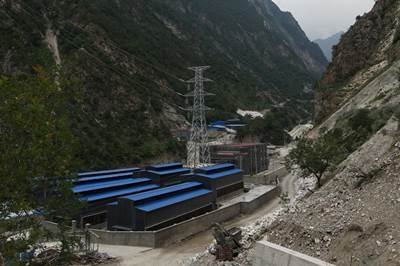
That one sentence pinpoints an essential aspect of the business model: cheap electricity. The following photo shows the bitcoin farm (blue roofs) colocated with a hydropower plant (red roof) in western China.


Multi-petahash BTC mine in Kangding, Sichuan, China (p.21)

Following are selected quotes from the thread, all discussing the importance of cheap electricity.

p.1

The equipment is actually relocated - the new location has cheaper electrical rate so it makes sense to relocate. We would have bought new ones but the supply has been tight and we deem the prices for the new ones are too high.

p.4

The electricity price in the new site is 43% cheaper than the previous one that we relocated from; the downside is that we will have to invest about RMB 4 million in the infrastructure. While the facility right now is filled with old machines of our own (about 5.3P), we have two warehouses under construction and are also looking to buy 6P worth of secondhand miners.

p.11

As some of you already know, I had been traveling. Right now I'm writing from my hotel room in Dalad Banner, a county-level administration in Inner Mongolia with a population of 0.34 million (according to Baidu Zhidao, the Chinese Wikipedia ). [...] The bus ride took 10 hours to bring us from the nameless valley we are located in to Chengdu. We arrived in late evening. We stayed in Chengdu that night and boarded the airliner from Chengdu to Hohhot the next morning. [...]

In the middle of nowhere, we saw this mammoth mine - I was told that it consumed half of the electricity the rest of the county collectively uses. Though I can't verify its claim being Asia's largest, it is obviously larger than ours in Kangding. But the thing is that the electricity that was regarded cheap a couple years ago, was no longer when compared with the newly discovered western Sichuan hydropower, so don't be surprised that it will be emptied over the next few months.

p.15

One caveat of relying on hydropower is that in winter, the supply is likely to be limited. • Q: Can you elaborate on why the hydropower would be limited in the winter? Something freezing somewhere? Electricity needed elsewhere? [...] Most likely the water freezes during the winter so the flow to the hydro station is substantially reduced. • A: More to do with the local precipitation pattern than temperature. We have been thinking of building mobile mines that can be towed by trucks like trailers.

p.16

[Quoting an external source] In spite of the a bright picture painted by the central government's "One Belt And One Road" plan for China's hydropower future, in parts of the country, imbalance of electricity consumption and development remains. Large amount of hydropower is "wasted", new projects are getting increasingly technically challenging, and the resettlement are becoming more and more costly – all threatening the healthy development of the industry.

Near the end of the thread, Eric Mu says, 'the total hashrate will eventually stabilize at 21 to 25 P'. That takes a lot of electricity.

21 November 2015

Bitcoin Mining Farm

Posting about bitcoin once a week gives me a regular opportunity to look into different aspects of the subject. One of the most interesting resources so far is on the 'Bitcoin Forum' (bitcointalk.org; see the navigation sidebar on the right): Three months living in a multi-petahash BTC mine in Kangding, Sichuan, China. The blog-like thread was maintained by Eric Mu, CMO of HaoBTC.
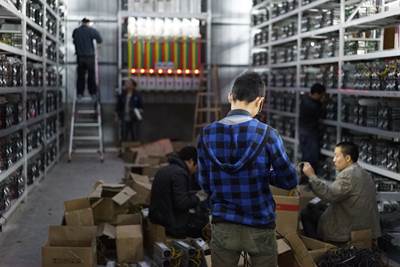
I have embarked on a three-month project working and living in a BTC mining farm located in the mountainous region of western Sichuan province. Using cheap hydro-power and low-cost water-cooling system, this farm has achieved high ROI rate. Right now it generates 4.7 petahash/sec and according to our plan will max at 12P over the next three to four months period.

CMO stands for 'Chief Marketing Officer' and HaoBTC 'provides innovative and well-rounded solutions for global Bitcoin users and investors' according to haobtc.com. The forum thread is full of photos like the following.

Vocabulary - Bitcoin [bitcoin.org] informs,

Hash Rate - The hash rate is the measuring unit of the processing power of the bitcoin network. The bitcoin network must make intensive mathematical operations for security purposes. When the network reached a hash rate of 10 Th/s, it meant it could make 10 trillion calculations per second.

For more, see What does One Petahash look like?; 'An Asicminer Blade is 10GH, so 1 PH is 100,000 of these.' For more from Eric Mu, see My Life Inside a Remote Chinese Bitcoin Mine [coindesk.com].

14 November 2015

Bitcoin 2.0

A couple of weeks ago, in my Halloween post Bitcoin : Trick -or- Treat?, I was baffled by a new term.
That last reference mentions 'Bitcoin 2.0 technology'. I wonder what that means.

The reference was When, Not If: Bitcoin in Israel, and the context was

There were two things that struck me as particularly interesting about the Tel Aviv Inside Bitcoins conference. First, there was a heavy emphasis on Bitcoin 2.0 technology. Presentations from Colored Coins, Ethereum, Mastercoin, Lazooz, and others played a significant role in the tone of the conference. I found this to be very interesting, especially as many throughout the globe are still trying to understand and utilize Bitcoin 1.0.

Google to the rescue, as usual. Its first search result was Bitcoin 2.0 Applications, where I found,

The technology underlying the system -- the blockchain and mining effort to confirm and validate transactions on the blockchain -- is potentially even more exciting and valuable than the currency. Bitcoin mining serves a dual purpose: it creates new bitcoins to increase the money supply and simultaneously secures and verifies the blockchain, which is a public ledger of every transaction.

While this functionality serves to keep internal bitcoin-bitcoin transactions valid, it can also be used to confirm and validate external, non-bitcoin specific transactions. In other words, this enables the application of decentralized public ledgers for purposes other than digital currencies. These applications are referred to as Bitcoin 2.0.

In other words, Bitcoin 1.0 is where you find the people who are interested in bitcoin for its libertarian angle, for the currency. Bitcoin 2.0 is where you find the technologists. Many people are in both camps.

Another interesting quote I found in 'Bitcoin in Israel' developed the other half of 'two things that struck [the author of the piece]'.

Second, which I found more surprising, was the fact that Bitcoin was seen as a clear and obvious inevitability, by all parties. Now for ordinary Bitcoiners, this doesn’t sound like a shocking statement, considering our natural optimism. But it wasn’t just Bitcoiners sharing this sentiment. There were speakers from Israeli Parliament as well as the Central Bank of Israel. I remember my jaw hitting the floor when I heard a Central Banker make reference to when Bitcoin becomes systematically valuable, just like the dollar or euro. Not if, but when.

I've encountered a similar sentiment in other sources. Why Israel?

07 November 2015

'Bitcoin Buy Online Books'

Getting back to Google Autocompletes 'Bitcoin Buy', my quest to actually buy something using bitcoin, Google's suggestion for the letter 'b' was 'bitcoin buy online books'. It turns out that the phrase can mean two different things: (1) 'buy books online paying with bitcoin' and (2) 'buy books about bitcoin online'. Since both activities are promising, I decided to combine them into 'buy books about bitcoin paying online with bitcoin'.

The first of the results returned was an Amazon.com link for 'Bitcoin: And the Future of Money' by [CNN Money reporter] Jose Pagliery. I doubt that Amazon accepts bitcoin directly -- and I can always use a credit card if I really want the book -- so I decided to continue searching. I did note that the book was '#31 in Books > Business & Money > Economics > Digital Currencies, a reference which might be useful later.

A significant number of search results appeared on the theme of 'What is an Order Book?', as in Bitcoin Trading: Interpreting Order Books. Thanks to a longtime personal interest in investing and markets, I'm already familiar with the term, and didn't need to spend any time on the subject.

Many search results led to outdated pages like Where to Spend Your Bitcoins (October 2012). Here a comment directed me to SynergeticPress.com, 'first book publisher to accept bitcoin for payment'. I couldn't find any books about bitcoin, so I noted the resource for future reference and moved on. It was reassuring to know that I'm not the only person who can't figure out what to do with bitcoin.

Eventually I came to bitcoinbook.info, a sales page for 'Mastering Bitcoin' by Andreas M. Antonopoulos, one of the gurus for the bitcoin movement. Although several other references hinted that I could buy the book using bitcoin, the publisher's checkout page offered only credit card payment. Perhaps I overlooked something, so I'll come back to this later. While I was looking at different resources for the book, I found one that offered a PDF version marked 'Early Release: Raw and Unedited'. Try before you buy? I'm good with that.

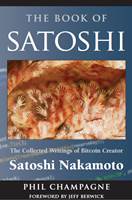
Most of the other resources that I encountered for books about bitcoin pointed to sales pages on Amazon. Finally I came to The Book of Satoshi.

Provides a convenient way to parse through what Bitcoin’s creator wrote over the span of the two years that constituted his "public life" before he disappeared from the Internet ... at least under the name Satoshi Nakamoto.

The page even had a link to 'Buy Ebook with Bitcoins', exactly what I was looking for! I followed the procedure to pay using my bitcoin wallet and about an hour later received an email informing me that 'Your files are ready to download'.

The book arrived in a ZIP file containing two formats -- EPUB & PDF -- and I immediately opened the PDF version to verify the content. In retrospect, it's completely appropriate that my first bitcoin purchase was for an ebook about the inventor of bitcoin. The entire exercise helped me to generate plenty of ideas for future blog posts.